Fractions
Fraction Practice Book
目次
- Fraction meanings
- Fractions
- Fractions on a numberline
- Fractions
- Introduction to Fraction
- Fraction Exploration
- Comparing Fractions
- Comparing fractions
- Comparing Fractions with Unlike Denominators Using Models
- Comparing Fractions using Models
- Comparing Fractions
- Equivalent fractions with area
- Addition with Fractions
- Addition of Fractions with Unlike Denominators
- Adding Fractions
- Adding Fractions with an Area Model
- Addition of fractions
- Fraction Addition (Intro)
- Subtraction with Fractions
- Fraction Subtraction
- Subtracting Fractions using an Area Model
- Subtracting fractions with number lines
- Subtracting Proper Fractions
- Subtraction of Fractions
- Multiplication with Fractions
- Multiplying fractions with area model
- Multiplying Fractions
- Multiplying Fractions
- Multiplying Proper Fractions
- Multiplication of Fractions
- Division with Fractions
- Dividing Fractions Using Visual Models
- Dividing Proper Fractions
- Dividing Fractions
- Division of fractions
- Equivalent Fractions
Fractions
Thinking about fractions
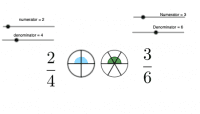
What have you noticed about the two fractions?[br]Think about the number and the amount of space that is colored.
How do you think you add fractions?
Denominator can not go higher then 12
https://www.geogebra.org/m/BTCSvEDZ
[math]\frac{1}{4}+\frac{2}{5}=[/math]
[math]\frac{1}{2}+\frac{1}{3}=[/math]
Comparing fractions
Visualize fractions using number lines and circles to better understand how to compare fractions.
Addition of Fractions with Unlike Denominators
Move the sliders to find the common denominators and implement the given addition.
Addition of Fractions with Unlike Denominators
Fraction Subtraction
Type two fractions on the right side and click the "Subtract" button on the left side. Explore a tape model that represents subtracting the two fractions. Click the "Reset" button to restart the animation of the model (click "Subtract" again).
Adapted from the [url=https://www.geogebra.org/m/EK55dCFh]Fraction Bar - Subtraction[/url] resource by Auston B Cron, who thanks Tang Dashi on the GeoGebra Forum. Adapted by [url=https://ies.ed.gov/ncee/rel/region/midwest]Regional Educational Laboratory Midwest[/url] for use with the Teaching Fractions Toolkit, which is based on the IES Practice Guide [url=https://ies.ed.gov/ncee/wwc/PracticeGuide/15][i]Developing Effective Fractions Instruction for Kindergarten Through 8th Grade[/i][/url].[br][br][url=mailto:ptierneyfife@edc.org]Contact us[/url] if this resource should be updated, or with questions or suggestions. We appreciate your help maintaining the quality of this resource.
Multiplying fractions with area model
Multiplying fractions using the area model. This applet will demonstrate why the algorithms for multiplying fractions make sense.
Dividing Fractions Using Visual Models
Divide a fraction by another fraction with unlike denominator using a visual model in this activity.
Putting It All Together
[i]Answer these open ended questions on your own or with others to form deeper math connections.[/i]
When both fractions have a common denominator, does it make dividing fractions easier or more difficult? Explain.
Jose noticed that [math]\frac{5}{8}\div\frac{3}{8}[/math] is the same as [math]5\div3[/math]. However, he isn't sure this strategy will work with [math]\frac{5}{8}\div\frac{3}{5}[/math]. Will his strategy work? If so, explain why. If not, describe what he can do to find the quotient.
Mary noticed that [math]\frac{4}{15}\div\frac{2}{3}[/math] can be solved by dividing straight across [math]\left(\frac{4\div2}{15\div3}\right)[/math]. Is this true for all fraction division? Explain.