1108 A lemma
In mathematics, a [i]lemma[/i] is a proposition, problem (theorem) which is applied to solve another problem. The following problem will be referred later as “a lemma”. It is remarkable in itself not only in hyperbolic or spherical geometry, but also in Euclidean geometry.
Problem:
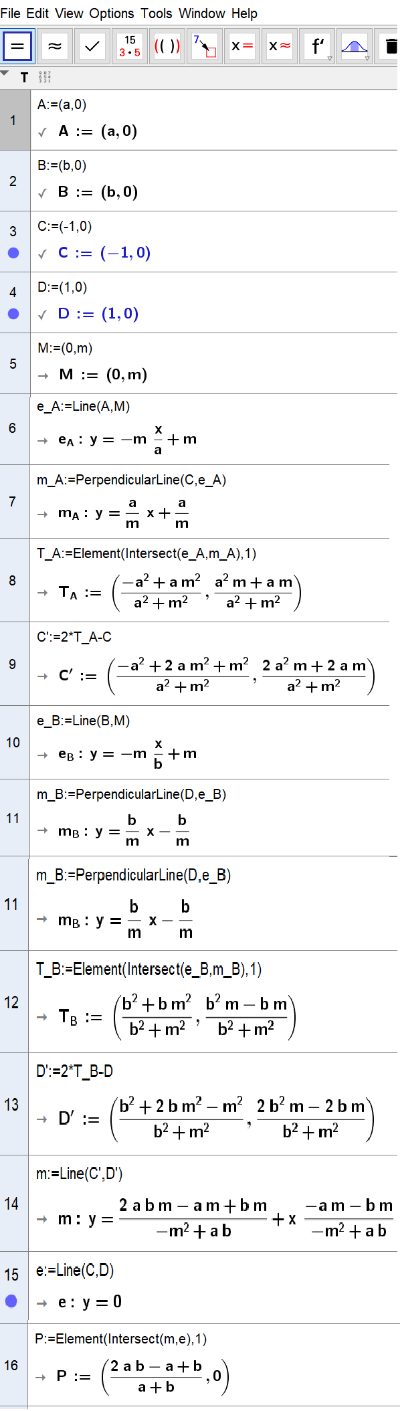
Given collinear points [i]A, B, C, D[/i], and point [i]M[/i] moving on the perpendicular bisector of segment [i]CD[/i]. Let [i]C'[/i] be the mirror image of point [i]C [/i]w.r.t. line ([i]AM[/i]), and point [i]D'[/i] the mirror image of point [i]D[/i] w.r.t. line([i]BM[/i]). Show that ([i]CD[/i])Ç([i]C’D’[/i])is independent of choosing point [i]M[/i].
For users of dynamic geometry software the question can be reformulated: What can be said about line ([i]C’D’[/i])? Investigate the question both in the P-model and in spherical geometry. [br][br]Firstly we demonstrate the statement in Euclidean geometry.
110801
Solution:
According to the construction, points [i]C, D, C’ [/i]and [i]D’[/i] are concyclic and they belong to a circle with center [i]M[/i]. Thus [i]p=PC·PD=PC’·PD’ [/i]for each point [i]M[/i] and all ([i]C’D’[/i]) secants, since a point [i]P [/i](that has already been constructed at least once) and [i]C[/i] and [i]D [/i]will uniquely define [i]p[/i], which is the power of the point [i]P[/i] w.r.t. all circles through both [i]C[/i] and [i]D[/i]. (A special case of the problem is the following: if [i]A[/i] and [i]B[/i] are symmetric to the perpendicular bisector [i]t[/i] of [i]CD[/i], then [i]C’D’║CD.[/i])[br][br]It can be proven that point [i]P[/i] is a similarity point of circles [i]s[sub]A[/sub][/i] with center [i]A[/i] and radius [i]AC[/i] and [i]s[sub]B[/sub][/i] with center [i]B[/i] and radius [i]BD[/i], and point [i]P[/i] is uniquely defined by points [i]A[/i], [i]B[/i], [i]C [/i]and [i]D[/i]. Clearly, there must be a position of point [i]M[/i] that yields the common tangent [i]C'D'[/i] of [i]s[sub]A [/sub][/i]and [i]s[sub]B[/sub][/i] (the tangent which goes through [i]P[/i]). [br][br]In the proof above we referred to the product of secants and used the notion of similarity which indirectly implies the axiom of parallels.[br][br]On the other hand the construction can also be performed in the P-model in the same way. Here we only transmit a [u]conjecture[/u]. That is, the lines ([i]C'D'[/i]) depending on [i]M[/i] are elements of a pencil. However, this pencil can be [i]a set of concurrent lines[/i] with center [i]P[/i] which is independent of the choice of [i]M[/i]; or [i]a set of ltraparallel lines[/i] w.r.t. a line [i]p[/i] perpendicular to the line ([i]CD[/i]) and to all lines ([i]C'D'[/i]); or even [i]a set of asymptotically parallel lines[/i]. Hence we can consider this problem as a lemma of the following construction.
110802
110803 A visualization of the lemma in the P-model
110804 A visualization of the lemma on a sphere
The same kind of construction can be performed also in spherical geometry. As expected, the spherical lines—geodesics—([i]C'D'[/i]) are concurrent through a pair of opposite points.