
Pre-Algebra

Table of Contents
- Chapter One
- Integer Comparison and Operations
- Fractions and Decimals
- Ratios
- Unit Rate
- Quiz One
- Chapter Two
- Introduction to Variables
- Combine Like Terms
- Chapter Three
Integer Comparison and Operations
Lesson Objective:
Students will be able to compare integers using the different integer rules.
Student-Facing Learning Target:
I can compare integers using the integer rules.
Vocabulary:
1.) [b]Integer:[/b] the set of positive and negative numbers[br]2.) [b]Inequality:[/b] compares two amounts[br]3.) [b]Inequality Symbols:[/b] > means greater than[br] < means less than[br] [u]>[/u] means greater than or equal to[br] [u]<[/u] means less than or equal to[br] = mean equal to[br]4.) [b]Addition and Subtraction Rules of Integers:[/b] when two integers have the same sign, you add them together and then keep the sign; when two integers have different signs, you subtract them and keep the sign of the greater number[br]5.) [b]Multiplication and Division Rules of Integers: [/b]when two integers have the same sign, the answer is positive when two integers have opposite signs, the answer is negative
Do Now:
1. Show on the applet what 3 + 4 looks like.[br]2. Show on the applet what 7-2 looks like.[br]3. Show on the applet what 2- 7 looks like.
Part One: Compare Integers
When we compare integers, we use inequality symbols to determine which number is larger than the other.
1. Do you have more money in your bank account when you have $1 or -$100? Write an inequality to compare.
2. Do you have more money if you bank account says -$1 or if it says -$100? Write an inequality to compare.
Exercise 1:
Exercise 2:
Part Two: Add and Subtract Integers
1. The temperature outside when Denise went to bed was 2 degrees. Overnight, the temperature dropped 5 degrees. What is the temperature in the morning?
2. The temperature outside when Denise went to bed was -2 degrees. Overnight, the temperature dropped 5 degrees. What is the temperature in the morning?
3. The temperature outside when Denise went to bed was -2 degrees. Overnight, the temperature rises 5 degrees. What is the temperature in the morning?
Find the sum or difference of the integers below:
1. 9 - 11 =
2. -5 + (-5) =
3. -17 + 17 =
4. If your account balance is -$125, what does this mean?
Exercise 3:
Part Three: Multiply Integers
Part Four: Divide Integers
Part Five: Subtracting a Negative
When you subtract a negative, it is the same thing as [b]adding[/b] a positive.[br][br]Example:[br] 3 - (-4) = 3 + 4 = 7
Exercise 4:
Ordering Integers Practice Problems
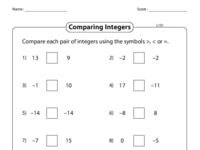
Comparing Integers Practice Problems
Introduction to Variables
Lesson Objective:
Students will be able to write expressions with variables to be able to identify the missing information in problems.
Student-Facing Learning Target:
I can write expressions with unknown numbers using variables.
Vocabulary:
1.) [b]Variable:[/b] a letter that stands for an unknown number [br]2.) [b] Expression:[/b] a group of symbols, variables, and numbers used to represent a value or an amount[br]3.) [b]Equation:[/b] a group of symbols, variables, numbers and has an equal sign[br]4.) [b]Substitution:[/b] the process of replacing a variable with a number
Do Now:
Erika's classroom has a width of 18 feet and a length of 20 feet. What is the area of Erika's classroom?
Part One: Using and Defining Variables
When we have unknown information we need to fill the spot with something. When it comes to math we fill the unknown information with a [b]variable[/b]. [br][br][br]1.) Sarah and Miranda combine their students for an activity.[br] a.) Write an expression to represent how many students are doing the activity.[br][br][b]Step One: Identify all information that is provided and identify variables.[br][/b] There are two classes being combined.[br] We don't know how many students are in Sarah's class so let us represent the number with S.[br] We don't know how many students are in Miranda's class so let us represent the number with M.[br] We don't know the total amount of students participating so let us represent the number with T.[br][br][b]Step Two: Identify the operation that is being used.[br][/b] When we think of combining two groups to find the total amount participating we use addition.[br][br][b]Step Three: Write an expression using variables when needed.[br][/b] S + M = T[br][br] b.) If Sarah had 12 students and Miranda had 6 students, how many students are doing the activity?[br][b]We now have numbers to plug in to our equation so we substitute the known information into the equation[br][/b] 12 + 6 = T[br] 18 = T[br] There are 18 students that are doing the activity.
2.) Israel makes $4.50 an hour working as a waiter.
a.) Write an expression to represent how much money Israel makes.[br][br]Let x represent hours and m represent the total money made.
b.) Write an expression to represent how much money Israel makes if he also made $125.65 in tips this week. Let x represent hours and m represent the total money made.
c.) How much money did Israel make with tips if he worked 10 hours this week?
3.) Maureen gives her daughter an allowance of $2 every week plus $0.50 for each load of laundry she does.
a.) Write an expression to represent how much money her daughter gets during the week. Let L represent the number of loads of laundry and A represent the allowance her daughter will receive.
b.) If her daughter did 3 loads of laundry this week, how much does Maureen owe her daughter?
4.) Anna and Elsa combined their tips, and then divided them equally.
a.) Write an expression to represent how much money each woman gets. Let A represent Anna's tips, E represent Elsa's tips, and T represent the total each gets.
b.) If Anna got $48 in tips and Elsa got $95 in tips, how much did each woman get after they combined their tips and split them?
Additional Practice Problems


